
The Unified Social Media Performance Framework: How to Bridge Organic and Paid Data
Unify organic metrics and paid boosting into a clear social media performance reporting framework to inform budget allocation and tactical amplification.
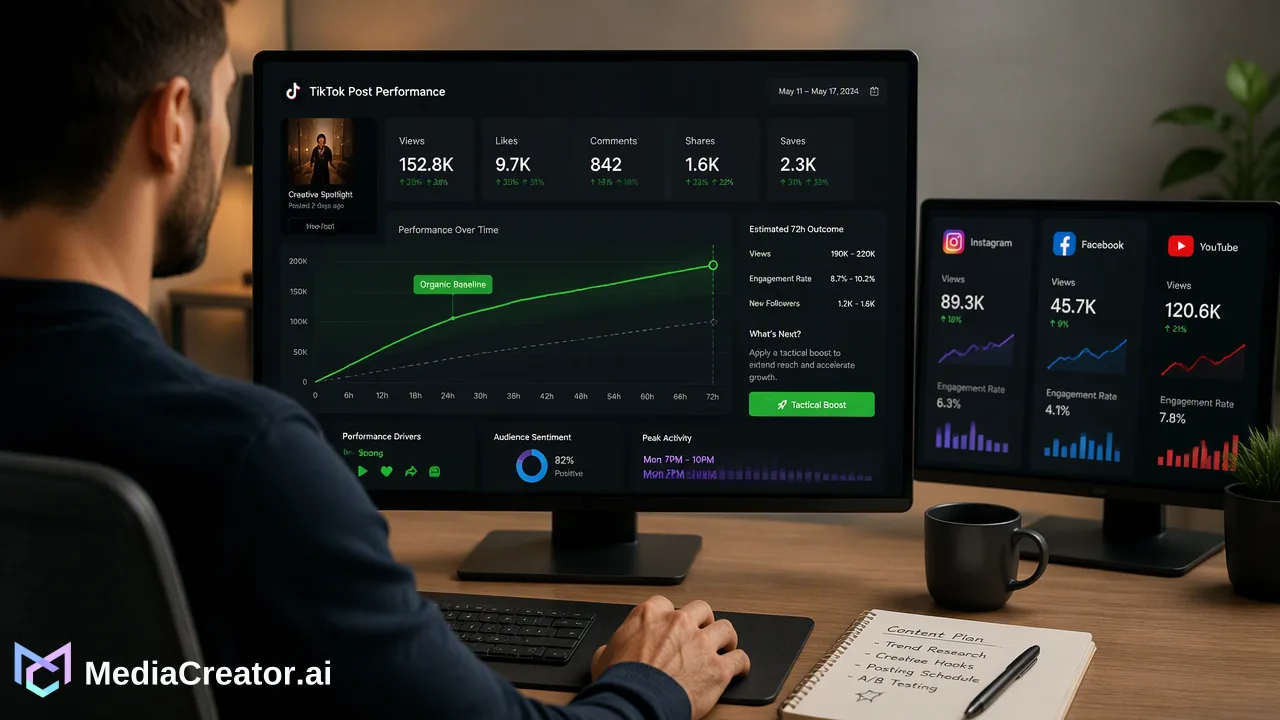
Learn how to build a unified social media performance reporting framework that connects organic metrics and tactical boosting to allocate budget effectively.
A unified social media performance framework bridges organic and paid data by centralizing cross-platform metrics into a single analysis workflow. Rather than evaluating organic engagement and paid amplification in isolation, marketing teams analyze organic post traction first to identify proven creative assets before committing budget to tactical boosts. This data-informed workflow avoids spending ad dollars on underperforming content and establishes clear, consolidated reporting across channels.
The Silo Problem in Social Media Reporting
Marketing teams frequently struggle with fragmented measurement when assessing social return on investment. In standard operations, organic social metrics live inside platform-specific creator portals, while paid promotion data resides in dedicated advertising consoles. This separation creates operational silos where organic content publishers and performance marketing managers evaluate the same asset through completely separate lenses. Siloed data leads to inefficient budget allocation. When performance marketers cannot quickly observe which organic posts generate sustained traction, paid spend is frequently deployed toward arbitrary or unproven creative concepts. Conversely, organic teams often lack visibility into how boosted posts perform relative to their initial organic trajectory. Native platform analytics rarely synthesize these views across multiple profiles or different social networks, leaving operators to manually pull spreadsheets and piece together disconnected timelines.
Defining the Role of Boosting
To build an effective reporting framework, teams must clarify the boundary between tactical boosting and comprehensive paid campaigns. Boosting is a targeted amplification mechanism designed to expand the distribution of an existing organic post. It serves primarily to extend the lifespan and impressions of content that has already shown positive organic response. In contrast, full-funnel campaign management within formal ads managers involves structured conversion tracking, custom audience exclusions, incrementality testing, and deep catalog integrations. Conflating these two tactics undermines measurement. Boosting cannot replace dedicated conversion campaigns, nor should it be used as a salvage operation for posts that failed to generate organic engagement. Attempting to rescue weak creative through paid distribution typically produces high cost-per-result metrics without delivering meaningful community response.
Building a Unified Performance Framework
A structured performance framework unifies social reporting by establishing common operational criteria before any paid budget is applied. Teams can structure this framework around three core principles:
| Operational Pillar | Focus Area | Reporting Requirement |
|---|---|---|
| Objective Definition | Reach vs. Engagement | Clarify whether the amplification target is broad impression volume or conversation depth prior to launch. |
| Centralized Auditing | Multi-Channel Visibility | Consolidate per-account and per-post analytics from TikTok, Instagram, Facebook, and YouTube into a shared view. |
| Threshold Evaluation | Organic Viability Baseline | Establish minimum engagement and watch-time milestones an asset must clear before qualifying for a boost. |
| Centralizing performance tracking is central to this methodology. MediaCreator.ai supports performance analytics across TikTok, Instagram, Facebook, and YouTube, enabling operators to review per-account and per-post performance in the web app. When social data across profiles is collected in one interface, stakeholders can compare content formats—such as short-form vertical video versus long-form community updates—using unified metrics rather than switching between divergent native analytics dashboards. |
Actionable Steps for Data-Informed Amplification
Implementing a unified framework involves a disciplined sequential workflow:
- Publish and Establish an Organic Baseline: Schedule and publish content across designated accounts. Use posting-time recommendations during calendar planning to give organic posts optimal distribution timing. 2. Monitor Early Velocity: Track engagement metrics during the initial 24 to 48 hours post-publication. Review per-post analytics inside the dashboard to identify content that outperforms historical baseline averages in shares, comments, or completion rates. 3. Apply Selective Amplification: Select only top-tier organic performers for tactical boosting. Assign concrete objectives—such as targeted audience reach or follower acquisition—matching the asset's existing organic strengths. 4. Audit Combined Impact: Review ongoing per-post performance to observe how paid impressions interact with organic reach over time, providing clean data to guide subsequent publishing cycles.
FAQ
Why should organizations wait before boosting a newly published post?
Waiting allows an organic baseline to develop naturally. By reviewing initial reach, watch time, shares, and comment rates over the first several hours or days, teams can verify whether the creative resonates with an audience before allocating budget. Boosting underperforming posts rarely corrects fundamental creative or messaging issues.
How does a unified dashboard improve social media performance reporting?
Native networks isolate performance data inside individual platform dashboards. A centralized dashboard aggregates per-account and per-post metrics across networks like TikTok, Instagram, Facebook, and YouTube into one view, reducing manual reporting overhead and helping teams compare organic traction across channels objectively.
What metrics should teams prioritize when evaluating organic content for amplification?
Teams should evaluate engagement rate, audience retention or average watch time, saves, and shares. High share and save volumes indicate that audiences find the material valuable enough to keep or distribute, making those posts safer candidates for paid distribution.
Learn More
Choose the product information that fits the next step in your workflow.
Get Started with MediaCreator.ai
Discover the power of AI-driven content creation
Related Articles
Continue learning with these related guides
The Collaborative Content Framework: How to Co-Author Social Campaigns with Creators
Discover how to co-author social campaigns with creators using a unified cross-platform publishing calendar and governed brand voice workflows.
BlogBuilding an Employee-Generated Content Program: A Workflow Guide for Modern Brands
Build a structured employee-generated content workflow. Learn how to align internal creators with clear briefs, review calendars, and unified social inboxes.
Blog