
From Data to Decisions: A Framework for Actionable Social Listening
Learn how to transform social listening metrics into strategic KPIs by bridging reactive monitoring, unified inbox workflows, and long-term planning.
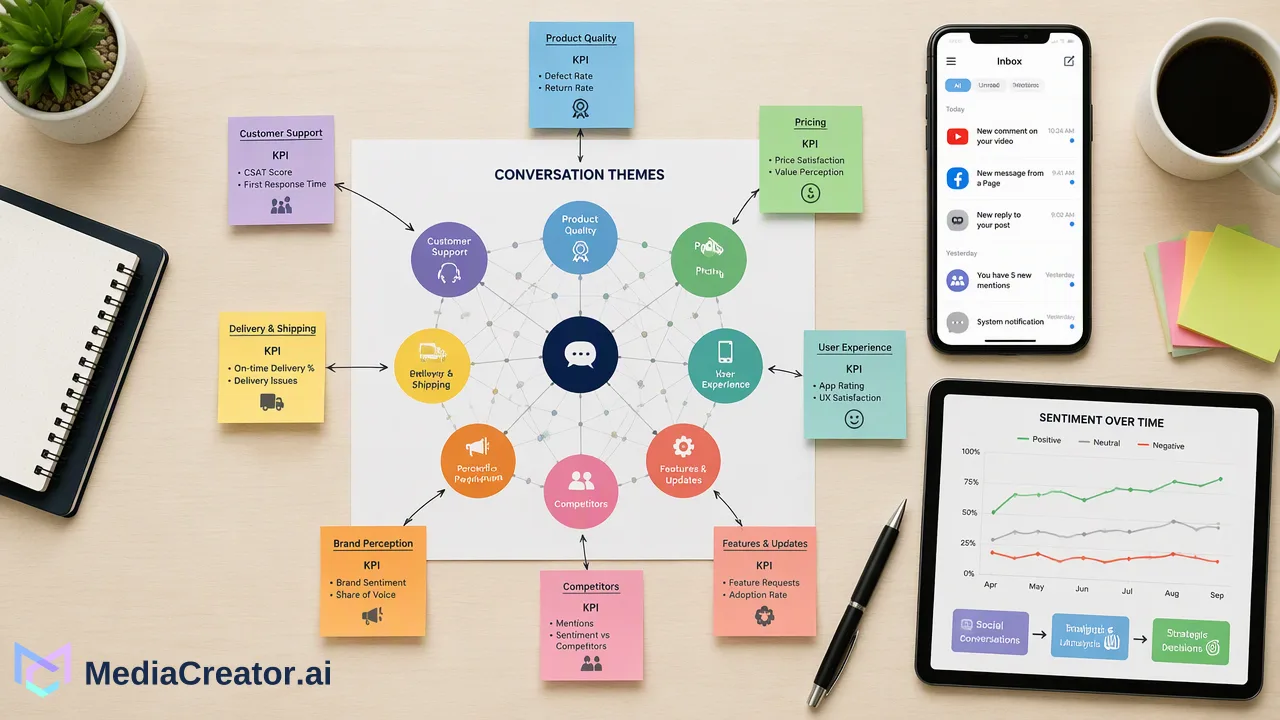
Discover how to turn social listening metrics into actionable business KPIs. Move from reactive monitoring to proactive planning with unified workflows.
Social listening transforms raw social data into strategic business intelligence by moving beyond reactive monitoring. By tracking essential social listening metrics—such as mention volume, sentiment, share of voice, reach, engagement rate, trend volume, and conversation themes—and aligning them with concrete business goals, teams shift from merely triaging individual notifications to proactively shaping editorial calendars, audience engagement workflows, and strategic planning.
Monitoring vs. Listening: The Strategic Shift
Many organizations confuse social monitoring with social listening, treating them as interchangeable activities. While both rely on incoming social data, they serve fundamentally different operational purposes. Social monitoring is inherently reactive. It focuses on the short term: identifying customer support requests, answering direct messages, acknowledging brand tags, and mitigating immediate PR complaints. Teams engage in monitoring to ensure no incoming message slips through the cracks. In contrast, social listening is proactive and analytical. Instead of focusing solely on isolated customer inquiries, listening analyzes macro-level conversation themes, sentiment patterns, and industry discussions over time. This approach allows organizations to understand audience context, identify unmet product needs, and adjust strategic initiatives before issues escalate. | Dimension | Social Monitoring | Social Listening | | :--- | :--- | :--- | | Primary Nature | Reactive and tactical | Proactive and strategic | | Time Horizon | Immediate (real-time response) | Longitudinal (weekly, monthly, quarterly) | | Core Data Scope | Direct mentions, DMs, incoming comments | Industry topics, brand sentiment, competitor presence | | Primary Objective | Fast query resolution and community triage | Content strategy, product insights, brand health |
The Seven Essential Metrics for Social Listening
To extract meaningful insight from high-volume social activity, organizations must focus on structured metrics rather than vanity numbers. Seven foundational metrics provide the baseline for comprehensive social listening:
- Mention Volume: The gross count of times a brand, product, or designated keyword is referenced across target channels over a specified period. 2. Sentiment: The contextual tone of conversations, categorizing commentary into positive, neutral, or negative sentiment to evaluate brand perception. 3. Share of Voice (SOV): The percentage of overall industry conversation that your brand commands in comparison to market peers. 4. Reach: The potential size of the audience exposed to relevant discussions, helping evaluate the distribution footprint of key narratives. 5. Engagement Rate: The proportion of interactions—such as likes, replies, and shares—relative to views or audience size, indicating how deeply a message resonates. 6. Trend Volume: The acceleration or deceleration of specific topics, hashtags, or keywords over time, identifying emerging consumer interests. 7. Conversation Themes: Qualitative clusters of recurring phrases, feedback patterns, or questions that reveal what audiences care about most.
Aligning Metrics with Business Objectives
Raw data becomes valuable only when linked directly to measurable business outcomes. Without a clear strategic framework, tracking social listening metrics risks generating reports that fail to inform commercial decisions. To bridge the gap between social data and executive strategy, teams must translate observations into key performance indicators (KPIs):
- Protecting Brand Equity: Track sentiment distribution alongside mention volume spikes to detect customer frustration early and measure the impact of operational updates. - Refining Content Planning: Analyze conversation themes and trend volume to guide future content production toward topics that audiences are actively discussing. - Assessing Market Share: Use share of voice to determine whether awareness campaigns are increasing your brand's presence within key industry discussions. Furthermore, social listening data should not exist in an isolated silo. Integrating social insights with customer relationship management (CRM) systems and broader marketing analytics platforms gives teams a more complete perspective on customer lifecycles. Connecting qualitative social sentiment with direct customer touchpoints helps marketing, product, and support teams make data-backed adjustments across their operations.
Operationalizing Insights with Unified Workflows
Gathering social listening data is ineffective if teams lack structured workflows to act on those findings. A major bottleneck in social operations is channel fragmentation, where managers must repeatedly log into separate interfaces to inspect incoming interactions. MediaCreator.ai addresses this challenge by centralizing multi-platform account management. Teams can connect accounts across TikTok, Instagram, Facebook, and YouTube via OAuth 2.0 without browser extensions or password sharing. By routing incoming comments, direct messages, and @mentions into a unified social inbox, community leads can review inbound sentiment, manage team replies, and monitor community dialogue from a single dashboard. Operationalizing listening also requires evaluating how past efforts performed. By pairing unified inbox oversight with built-in performance analytics, teams can review per-account and per-post performance across connected networks. Best-time recommendations then assist planners in scheduling future posts during historical windows of higher audience responsiveness.
Best Practices for Proactive Strategic Planning
Turning qualitative listening insights into structured business decisions requires disciplined operational habits. Teams can implement several best practices to keep their editorial strategy grounded in real audience data:
- Establish Routine Performance Reviews: Regularly evaluate historical metrics using per-account and per-post analytics. Identifying which themes consistently generate engagement helps editorial teams iterate on content concepts rather than guessing. - Maintain Voice Consistency at Scale: When adapting messaging to reflect trending conversation themes, teams can utilize AI-assisted drafting features like Nova AI or Quick Caption alongside MediaCreator.ai's Brand Voice setting to ensure tone remains consistent across platforms. - Preserve Human Editorial Control: Keep human review central to the publication workflow. In MediaCreator.ai, all AI write actions surface a confirm card before content is placed onto the publishing calendar, ensuring team members verify facts, tone, and positioning before any post goes live. - Plan Adaptations Visually: Use a centralized publishing calendar to organize posts into draft, queued, and published states, verifying each platform-specific preview before scheduling distribution.
FAQ
What is the difference between social monitoring and social listening?
Social monitoring is a reactive process centered on tracking mentions, direct messages, and comments to resolve immediate customer inquiries or operational issues. Social listening is a proactive, strategic practice that evaluates aggregate conversation patterns, sentiment, and emerging topics across platforms to guide broader business and editorial decisions.
How do teams turn social media metrics into business KPIs?
Teams turn metrics into KPIs by mapping each measurement directly to an organizational outcome. Rather than viewing mention volume or sentiment in isolation, teams correlate sentiment trends with customer satisfaction goals, use conversation themes to guide content roadmaps, and connect social engagement signals with CRM records to understand customer retention.
Why is a unified social inbox important for data-driven teams?
A unified social inbox aggregates comments, direct messages, and mentions across connected profiles into a single operational interface. This central collection point prevents fragmented oversight across multiple accounts and networks, allowing teams to review customer sentiment systematically and respond without switching tools.
Learn More
Choose the product information that fits the next step in your workflow.
Get Started with MediaCreator.ai
Discover the power of AI-driven content creation
Related Articles
Continue learning with these related guides
Building a Unified Social Media Tech Stack: A 2026 Guide to Integrated Workflows
Explore how an integrated social media management tech stack unifies scheduling, AI drafting, and inbox tracking across major networks.
BlogBuilding a Brand Safety Governance Framework: A Guide to Enterprise Risk Mitigation
Learn how to build a social media brand safety governance framework with human-in-the-loop workflows, brand voice controls, and multi-account oversight.
Blog