
The Threads Growth Playbook: Workflows for Text-First Social Media Strategy
Build a scalable text-first social media strategy with proven workflows for conversational posting, brand voice consistency, and structured drafting.
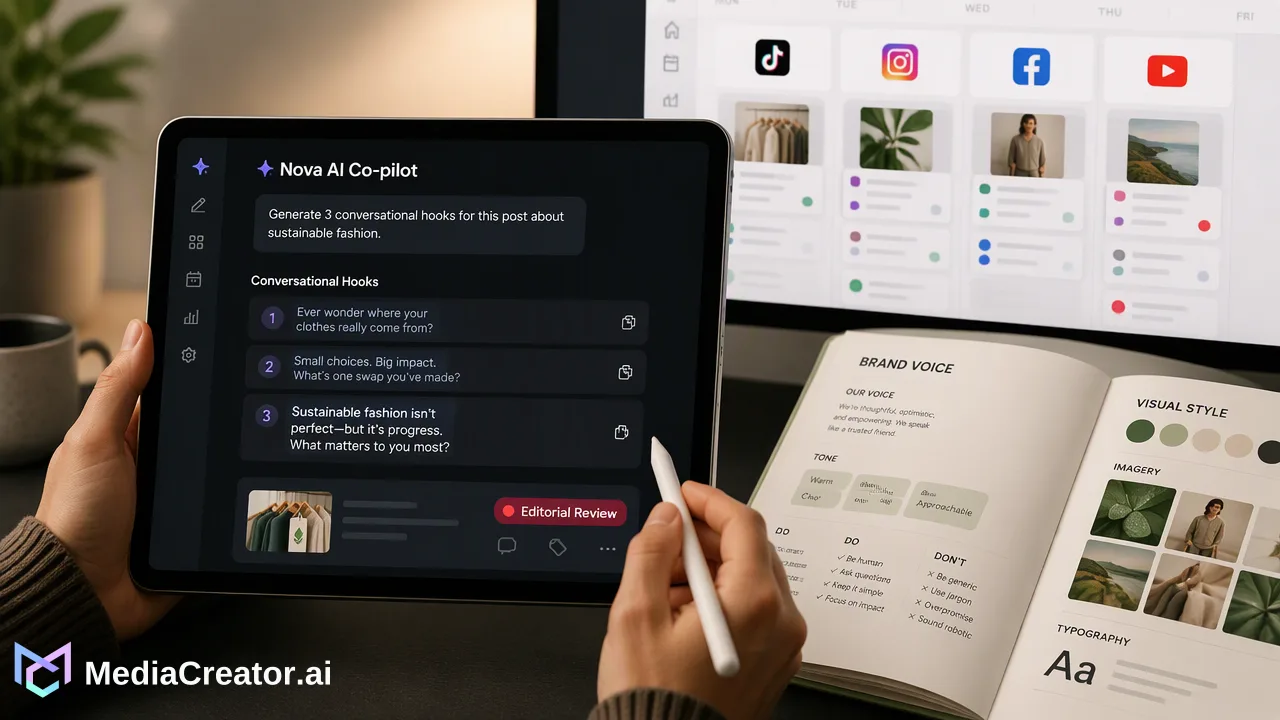
Mastering a text-first social media strategy requires shifting from visual broadcasting to conversational community interaction, structured drafting, and disciplined brand voice.
Succeeding with a modern threads social media strategy requires transitioning from high-production visual broadcasting to authentic, text-first conversation. Rather than treating a feed as an announcement board, high-performing teams treat text networks as open forums where concise points, active replies in niche discussions, and consistent perspective drive visibility. Managing this shift alongside existing visual channels requires structured editorial workflows: maintaining unified calendars to align messaging, using AI drafting tools with mandatory editorial review, and adapting long-form or visual concepts into focused, conversational discussion prompts.
The Shift to Text-First Engagement
Social media workflows historically prioritized polished, media-heavy creative assets. Channels such as Instagram, TikTok, and YouTube reward visual composition, high frame rates, and sound design. However, the rise of modern conversational feeds demands an entirely different operating model. Text-centric platforms function as hybrid forums, combining the personal identity of social profiles with the discussion dynamics of public message boards.
On conversational channels, audiences scroll seeking perspectives, quick debates, industry analysis, and real-time commentary. Static broadcasting—publishing a single one-way announcement and walking away—rarely generates traction. Instead, traction stems from active participation in niche discussions. Teams that treat their profile as a community participant rather than a commercial billboard uncover greater organic dialogue.
| Operating Dimension | Visual-First Strategy | Text-First Strategy |
|---|---|---|
| Core Currency | Production value, motion, aesthetic | Clarity of thought, prompt replies, concise phrasing |
| Content Objective | Passive consumption, saves, link clicks | Active replies, debate, participatory commentary |
| Community Posture | Broadcast-and-monitor | Ongoing conversation and forum contribution |
| Production Cycle | Hours to days per creative asset | Minutes of focused drafting and continuous response |
Transitioning to this text-forward model requires social teams to reconsider their production pipeline. Because writing can be produced and iterated rapidly, speed and conversational relevance replace extensive rendering timelines.
Building a Consistent Brand Voice
Conversational networks expose inconsistent tone far more quickly than static graphic banners. In a forum-style ecosystem where a brand posts multiple times daily and responds to diverse comments, maintaining an authentic and recognizable voice is essential for brand credibility.
Establishing this consistency involves defining core communication parameters:
- Vocabulary and Register: Specify whether team communications lean academic, technical, witty, or plainspoken.
- Point of View: Articulate clear organizational viewpoints on industry topics so responses reflect genuine institutional knowledge.
- Interaction Boundaries: Establish guidelines for when to engage in community debates and when to remain neutral.
When scaling copy creation across multiple writers or leveraging assistive tooling like the Nova AI Co-pilot, governance becomes critical. MediaCreator workflows emphasize that AI-assisted writing requires user review before publish to ensure brand alignment. Drafting tools can synthesize research notes or generate alternative headline hooks, but designated social editors must review every conversational prompt against brand voice profiles before distribution.
Optimizing Your Publishing Workflow
Managing text-based conversations requires disciplined operational infrastructure. Because conversational platforms move quickly, teams can easily become reactive, posting sporadic thoughts without strategic coherence. A structured workflow prevents burnout while ensuring message alignment.
Using a unified publishing calendar to manage multi-platform content ensures that text-based updates are scheduled alongside visual assets for a cohesive brand presence. Within comprehensive social media management platforms like MediaCreator, operations leads organize campaigns across major networks—such as TikTok, Instagram, Facebook, and YouTube—tracking drafts, scheduled queues, and published states from a central vantage point.
To build a repeatable conversational workflow, teams typically follow a tiered staging process:
- Topic Ideation: Identify three to five weekly themes anchored in original data, current news, or frequently asked audience questions.
- Prompt Drafting: Generate concise standalone posts that invite feedback, using conversational frameworks such as "question plus perspective" or "counterintuitive observation."
- Editorial Review: Verify alignment with brand guidelines and verify that accompanying links or references are accurate.
- Scheduled Orchestration: Align text discussions with visual launches across connected channels, ensuring audiences encountering a video campaign also find relevant contextual commentary on conversational feeds.
Repurposing Content for the Thread Format
A common mistake when expanding into conversational channels is copy-pasting visual captions directly into text-based feeds. Captions written to support an Instagram Reel or a YouTube video often rely heavily on the visual context to make sense. Stripped of that footage, the copy often feels disconnected or hollow.
Cross-platform content repurposing must be adapted to fit the specific thread format rather than simply copying posts across networks. When adapting multimedia concepts for text-first environments, consider these tactical adjustments:
- Extract the Core Thesis: Pull the most provocative insight or takeaway from a script and frame it as an opening hook.
- Break Down Complex Narratives: Deconstruct multi-minute video explanations into sequential, digestible statements that encourage readers to scroll and comment.
- Replace Hashtag Clutter with Direct Inquiries: Swap generic promotional tags for a focused concluding question that directly invites user replies.
Tools like Quick Caption assist this transformation by generating platform-adapted copy variations from source video or imagery. However, tailoring long-form content into a resonant discussion thread ultimately hinges on understanding forum reader behavior: opening with value, maintaining concise cadence, and actively stewarding the replies that follow.
FAQ
How does a text-first social media strategy differ from visual-first approaches?
Visual-first strategies focus on finished assets such as polished video, curated graphics, and narrative imagery designed for passive consumption. In contrast, a text-first strategy functions more like an interactive forum. Success depends on concise written statements, thought-provoking perspectives, and prompt participation in replies. Value is measured by conversational depth and community back-and-forth rather than visual production value.
What is the most effective way to maintain a consistent brand voice across conversational channels?
Organizations maintain tone by codifying explicit voice profiles—such as formal, analytical, or approachable—and pairing them with documented response guidelines. When utilizing AI assistants to draft copy, human editors review every draft against these voice parameters to ensure phrasing, perspective, and terminology remain aligned before anything is shared with audiences.
How can marketing teams balance automated drafting with authentic community interaction?
Teams balance efficiency and authenticity by dividing duties between preparation and direct engagement. Drafting assistants and scheduled calendars handle baseline prompts, topic outlines, and content schedules. However, direct interactions—such as answering questions, participating in community threads, and handling customer dialogue—remain led by human community managers.
Learn More
Choose the product information that fits the next step in your workflow.
Get Started with MediaCreator.ai
Discover the power of AI-driven content creation
Related Articles
Continue learning with these related guides
The Hidden Cost of 'Smart' Tech: Why Your Content Workflow Should Stay Lean
Learn how structured publishing caps, controlled media storage, and lean automation support digital efficiency across modern social media workflows.
BlogHow to Calculate and Benchmark Social Media Engagement Rates in 2026
Learn how to perform social media engagement rate calculations in 2026. Compare reach versus follower formulas and benchmark using your historical data.
Blog