
Social Media Optimization: A Workflow Guide for Modern Marketers
Learn how to build a data-driven social media optimization strategy using centralized workflows, AI assistance, and cross-platform publishing tools.
Learn how to build a data-driven social media optimization strategy using centralized workflows, AI assistance, and cross-platform publishing tools.
Social media optimization (SMO) is the strategic refinement of profiles, content, and posting schedules to improve discoverability and engagement. As social platforms increasingly function as search engines, marketing teams must adopt a data-driven approach to content distribution. Effective optimization requires updating bios with relevant keywords, maintaining consistent branding across channels, and utilizing centralized management tools to analyze performance. By replacing manual guesswork with structured workflows and AI-assisted scheduling, organizations can scale their social presence while retaining human oversight over all published content.
The Evolution of Social Media as a Search Engine
Social networks have transitioned from chronological feeds into complex discovery engines. Users now rely on these platforms to search for brands, products, and educational content, making discoverability a primary focus for modern marketers. Social media optimization starts with the foundational elements of a profile. Organizations must update bios, handles, and captions to be keyword-rich and aligned with what their target audience is actively searching for. When platforms function as search engines, optimization is no longer limited to individual post performance. It requires a strategic alignment of tone, timing, and content mix across the entire account. A well-optimized profile acts as a digital storefront, guiding users from initial discovery to deeper engagement. Teams that treat their social channels as searchable databases can better structure their content to surface in relevant queries, ultimately supporting broader marketing objectives.
Building a Data-Driven Optimization Workflow
Transitioning from manual posting to a structured social media optimization strategy requires a reliance on data rather than intuition. A data-driven workflow involves continuously analyzing past performance to inform future content decisions. Instead of guessing when an audience might be online, teams can utilize intelligent analytics to surface best-time-to-post recommendations. MediaCreator.ai supports this workflow by providing analytics recommendations that help teams schedule content during optimal windows. By integrating these insights into a daily routine, social media managers can reduce the manual guesswork traditionally associated with content calendars. Furthermore, a data-backed approach allows organizations to identify which content formats resonate most effectively, enabling them to refine their visual and written assets over time. Consistent measurement and adaptation form the core of a sustainable optimization framework.
Scaling Consistency Across Platforms
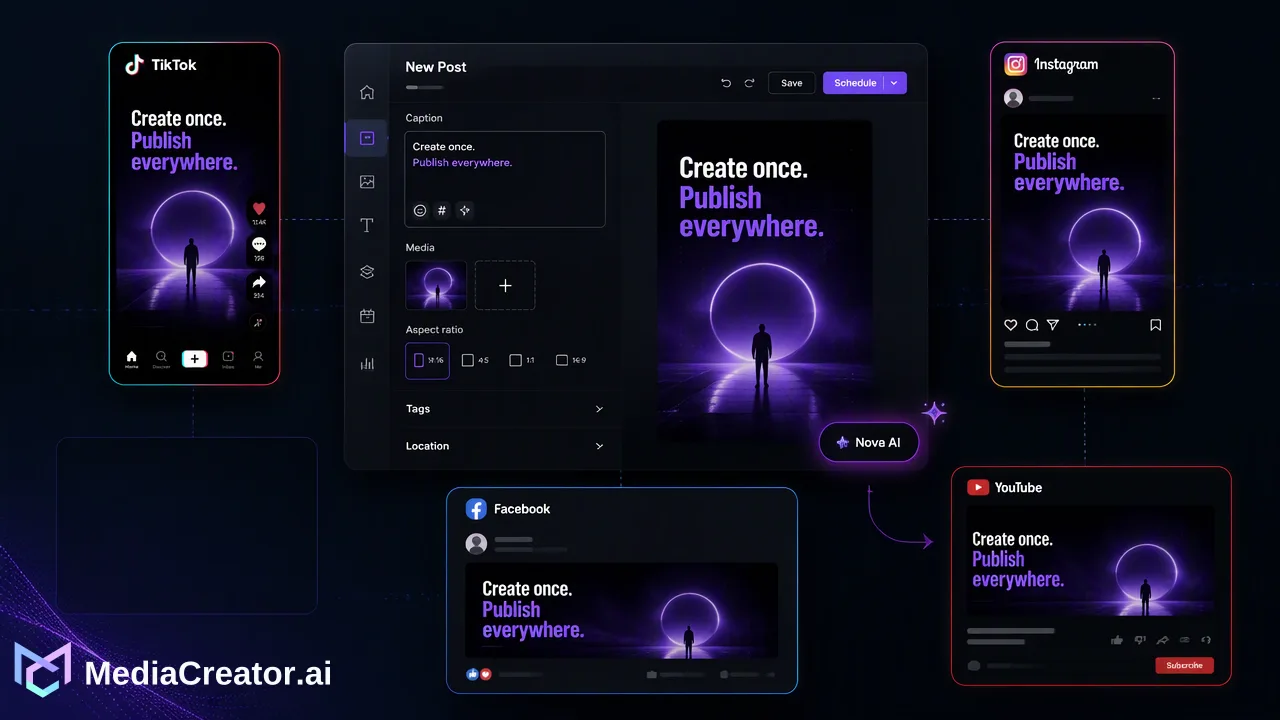
Managing a cohesive brand presence becomes exponentially more difficult as organizations expand across multiple networks. Centralized management tools are essential for scaling optimization efforts without fragmenting the brand voice. MediaCreator.ai provides a web-based Social Account Dashboard that allows teams to connect and manage multiple accounts per supported platform through standard OAuth 2.0 connections. This infrastructure supports TikTok, Instagram, Facebook, and YouTube without requiring password sharing or browser extensions. A unified workflow enables teams to compose a core message once and adapt it for each specific network. Using a visual calendar, marketers can track assets through draft, queued, and published states. Before any content goes live, per-platform previews allow teams to verify how media and captions will render natively on TikTok versus YouTube or Instagram. This centralized approach supports accessibility standards and consistent branding, regardless of where the audience encounters the content. Additionally, bringing comments, direct messages, and mentions into a unified inbox helps teams manage engagement efficiently across all connected accounts.
The Role of AI in Modern SMO
Artificial intelligence serves as a powerful accelerator for social media optimization, provided it is deployed as an assistant rather than an autonomous replacement for human strategy. Modern workflows utilize AI to overcome creative blocks, adapt messaging for different formats, and streamline the drafting process. MediaCreator.ai offers optional AI features, including Nova AI, which acts as a co-pilot for post drafting and workflow assistance. For visual and written assets, tools like Content Studio support AI image and video generation, while Quick Caption generates platform-adapted copy based on uploaded media. However, maintaining brand integrity requires strict governance over automated outputs. To confirm that all AI-generated content meets organizational standards, MediaCreator.ai utilizes a confirm-first workflow. AI write actions display a confirm card, requiring explicit user approval before anything is published. This structure allows marketing teams to benefit from the speed of AI-assisted content creation while retaining complete human control over the final optimization strategy.
FAQ
What is the first step in social media optimization?
The first step in social media optimization is refining profile discoverability. Because social platforms increasingly function as search engines, teams must update bios, handles, and captions to include relevant keywords that align with user search intent.
How do organizations maintain brand consistency across multiple social platforms?
Organizations maintain consistency by utilizing centralized management tools. Platforms like MediaCreator.ai allow teams to manage TikTok, Instagram, Facebook, and YouTube from a single dashboard. Features like visual calendars and per-platform previews help teams adapt content for specific networks while keeping the core brand message unified.
Can AI assist with social media optimization without compromising brand voice?
Yes, AI can assist with optimization when used as a co-pilot for drafting and caption generation. To maintain brand voice, workflows should require human oversight. MediaCreator.ai utilizes a confirm-first approach, displaying a confirm card for AI write actions so teams can review and refine content before publishing.
Why is a centralized dashboard important for a social media optimization strategy?
A centralized dashboard is essential for scaling optimization efforts across multiple networks. It allows teams to connect accounts via OAuth 2.0, manage visual calendars, preview per-platform rendering, and consolidate engagement into a unified inbox, reducing the manual switching between different applications.
Get Started with MediaCreator.ai
Discover the power of AI-driven content creation
Related Articles
Continue learning with these related guides
How to Optimize Your Social Content for AI Search Visibility
Learn how to build an AI search optimization strategy using creator-led social content, unified workflows, and consistent brand messaging across platforms.
BlogHow to Optimize Your Facebook Business Page for Professional Social Media Management
Learn how facebook business page optimization helps teams manage brand presence, collaborate securely via OAuth, and streamline cross-platform publishing.
BlogMastering Social Media Algorithms: A Workflow Guide for Algorithmic Optimization
Learn how a structured social media algorithm optimization workflow helps teams adapt content, schedule posts, and review cross-platform analytics.
Blog