
Integrating AI Agents into Your Social Media Workflow Using MCP
Learn how the Model Context Protocol (MCP) streamlines social media AI agent integration, connecting tools like MediaCreator.ai without manual data exports.
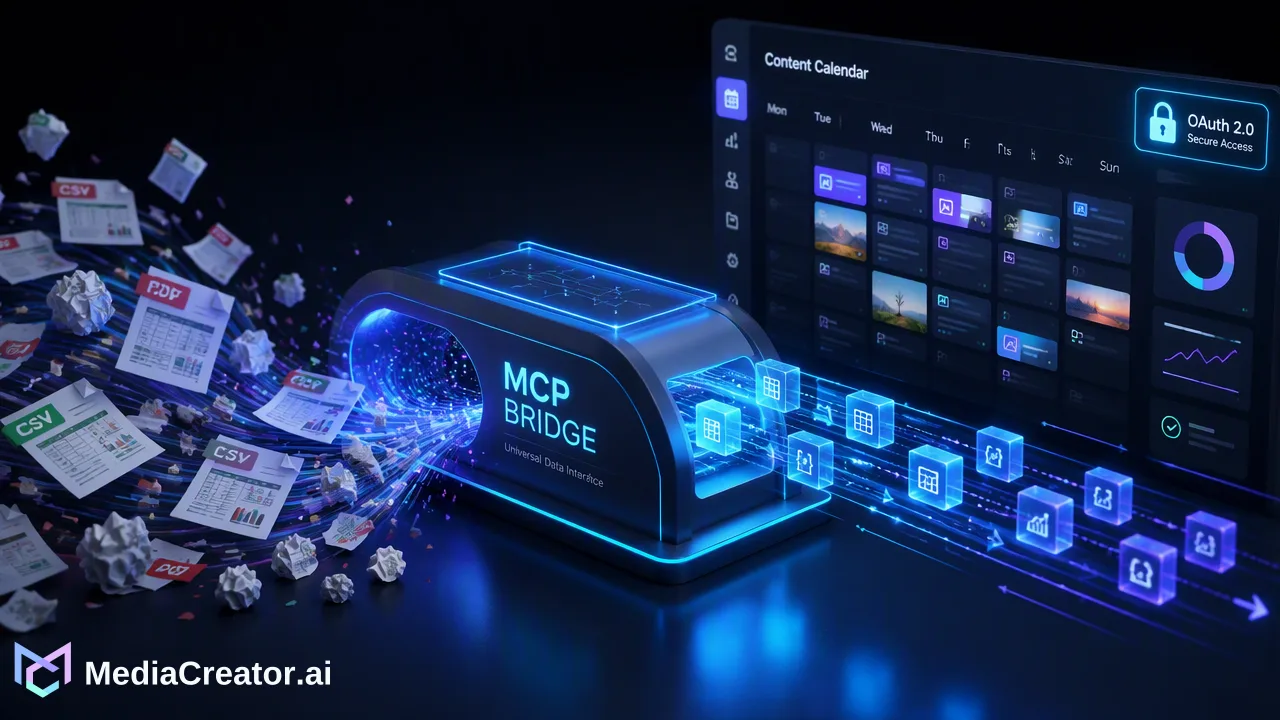
Learn how the Model Context Protocol (MCP) acts as a standardized bridge for social media AI agent integration, helping teams connect tools like MediaCreator.ai without manual data exports.
The Model Context Protocol (MCP) provides a standardized interface that helps AI agents connect directly with social media management tools. By acting as a universal bridge, MCP helps AI retrieve real-time data from content calendars, analytics, and engagement inboxes, reducing manual data exports. This social media AI agent integration supports more autonomous, context-aware workflows while maintaining necessary human oversight.
The Evolution of Social Media Workflows
Social media management traditionally requires significant manual data handling across multiple disconnected platforms. Teams often move information between content calendars, analytics dashboards, and drafting environments. This manual data copying between tools creates friction in content creation and reporting workflows. When teams rely on isolated systems, they must export performance metrics as CSV files, paste them into reporting tools, and manually transfer drafted copy into scheduling interfaces. This fragmented approach slows down operations and limits the speed at which organizations can adapt to audience engagement. As social media operations scale, the need to reduce this "copy-paste" friction becomes critical. Without a unified data layer, AI assistants are limited to the context manually provided by human operators, which often results in generic outputs that lack awareness of the brand's actual publishing schedule or historical performance.
What is the Model Context Protocol (MCP)?
The Model Context Protocol (MCP) acts as a standardized bridge between AI models and external social media tools. Historically, connecting an AI assistant to a proprietary database or software platform required custom code for every individual connection. MCP replaces this fragmented approach by providing a universal interface for AI agents. Traditional API vs. MCP Integration
- Traditional API: Requires bespoke code for each tool, high maintenance overhead, and manual updates when endpoints change.
- MCP Integration: Provides a universal interface, helps AI query multiple tools through a standardized protocol, and reduces custom development requirements. Instead of building bespoke API integrations for every new tool, developers and organizations can use MCP to give AI models direct, structured connections to external data sources. In a social media context, this means an AI agent can securely query a content calendar, retrieve historical performance data, or read incoming engagement metrics without requiring a human operator to export and upload files. This standardized communication layer fundamentally changes how AI assists with operational tasks, moving from isolated text generation to context-aware workflow support.
Integrating AI Agents with Social Media Management
Implementing social media AI agent integration transforms how teams manage their daily operations. By utilizing MCP, AI agents can retrieve real-time data directly from content calendars and analytics dashboards. This integration supports more autonomous workflows without manual exports, helping AI draft platform-adapted copy based on current trends or historical performance. When applying this to a unified dashboard like MediaCreator.ai, the workflow becomes highly centralized. MediaCreator.ai supports TikTok, Instagram, Facebook, and YouTube via OAuth 2.0 connections. Because the platform utilizes OAuth 2.0, teams can connect these supported social accounts without password sharing or requiring browser extensions. An AI agent connected via MCP can interact with this unified environment to retrieve data across multiple accounts per supported platform. For example, the agent can analyze comments, direct messages, and mentions from the unified social inbox. It can also review the visual calendar's draft, queued, and published states to inform future content recommendations. MediaCreator.ai includes optional AI features such as Nova AI (a co-pilot for post drafting), Quick Caption (for generating platform-adapted copy based on uploaded media), and Content Studio (for AI-assisted image and video generation). When an AI agent interfaces with these tools via MCP, it can seamlessly pass context—such as a successful past campaign—directly into the Content Studio or Nova AI to inform new drafts, keeping all work in one place.
Maintaining Human Oversight and Security
While MCP supports deep connectivity, security and governance are critical when granting AI agents connections to social media accounts and data. Organizations must verify that AI integrations do not bypass established approval workflows or compromise account security. Utilizing OAuth 2.0 connections provides a secure foundation by authenticating access without exposing raw credentials to the AI model or third-party interfaces. Furthermore, operational governance requires a strict human-in-the-loop approach. AI-driven actions, such as post drafting or media generation, should always include a human-in-the-loop confirm card before publishing. In MediaCreator.ai, all AI write actions display a confirm card before any content goes live. This confirm-first behavior supports human operators in retaining final editorial control while the AI agent handles the heavy lifting of data retrieval and initial drafting via MCP. Teams can preview per-platform rendering for TikTok, Instagram, Facebook, and YouTube before approving the post. This balance of standardized AI connectivity and strict publishing governance helps teams scale their output safely, supporting workflows where no automated system can publish directly to a brand's feed without explicit human authorization.
FAQ
How does MCP differ from traditional API integrations?
Traditional APIs typically require custom code for every individual connection between an AI model and a software tool. The Model Context Protocol (MCP) provides a universal, standardized interface. This helps AI agents act as a bridge to external social media tools without needing bespoke development for each new data source, reducing manual data copying and integration friction.
Can AI agents publish content automatically using MCP?
While MCP helps AI agents retrieve real-time data and draft content, best practices and platform governance require human oversight. For example, within MediaCreator.ai, AI-driven actions utilize a confirm-first behavior. The system displays a confirm card before publishing, supporting human operators as they review and approve all AI-generated drafts before they are posted to connected accounts.
What security measures are necessary when integrating AI agents with social media accounts?
Security and governance are critical when granting AI agents connections to social media data. Organizations should use secure authentication methods, such as OAuth 2.0, to connect accounts without sharing passwords. Additionally, maintaining a human-in-the-loop workflow helps teams verify that AI agents cannot execute unauthorized write actions, keeping editorial control firmly with the human operators.
Get Started with MediaCreator.ai
Discover the power of AI-driven content creation
Related Articles
Continue learning with these related guides
Building a Proactive AI Social Listening Workflow: Turning Insights into Strategic Action
Learn how to build a proactive AI social listening workflow to centralize conversations, analyze post performance, and guide your social media strategy.
BlogThe Data Storyteller’s Workflow: How to Turn Social Media Metrics into Actionable Insights
Learn a social media data storytelling workflow to turn raw analytics into strategic publishing decisions across TikTok, Instagram, Facebook, and YouTube.
BlogHow to Integrate Boosted Reels into Your Social Media Publishing Workflow
Integrate boosted Instagram Reels into your social publishing workflow. Balance organic planning, eligibility, brand voice, and analytics.
Blog