
How to Build a Scalable Social Media Workflow: A Guide to Automation and Governance
Learn how to build a scalable social media workflow automation process. Centralize operations, integrate AI, and maintain brand consistency with human governance.
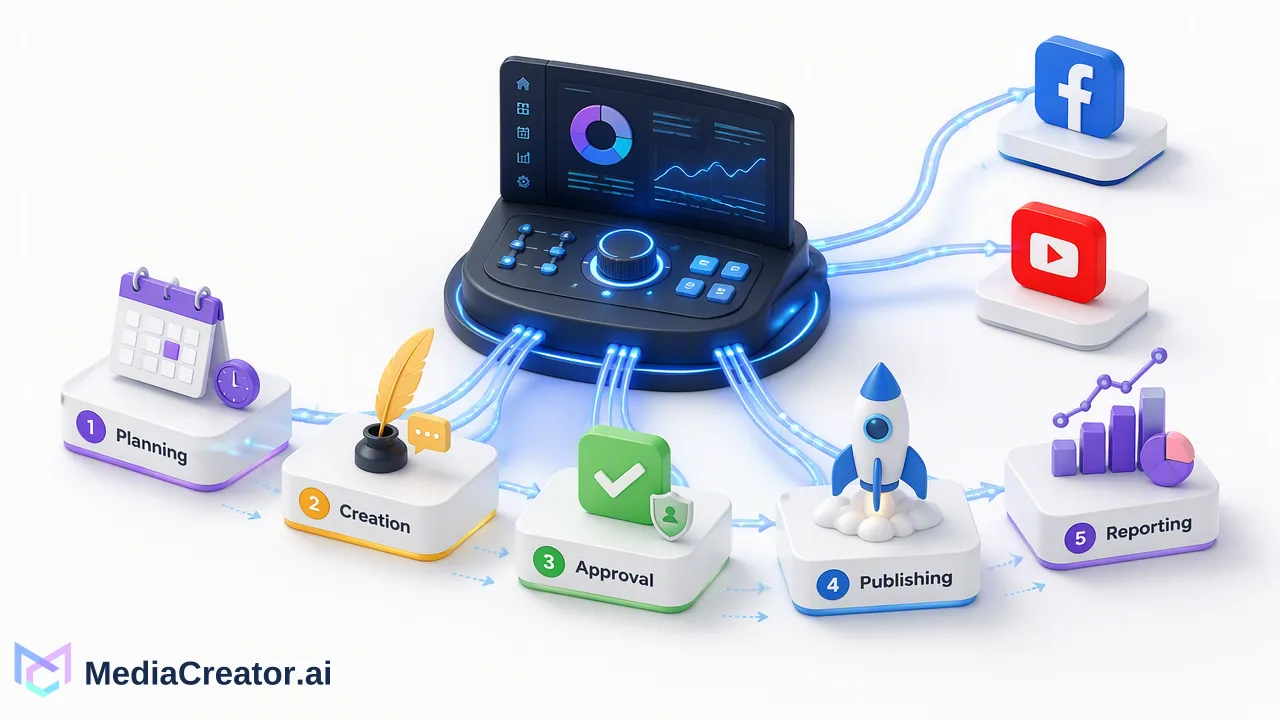
A comprehensive guide to building a scalable social media workflow by centralizing operations, implementing human-led governance, and leveraging AI for operational efficiency.
A scalable social media workflow relies on centralizing operations into a single system to eliminate tool friction. By segmenting the process into planning, creation, approval, publishing, and reporting, teams maintain brand consistency. Integrating AI for drafting and media generation accelerates output, provided that human-led governance and approval steps remain the final gatekeeper for all content. A repeatable, step-by-step process for content creation, approval, and publishing is essential for maintaining brand consistency and operational efficiency at scale.
The Importance of a Standardized Social Media Workflow
Organizations attempting to scale their digital presence often encounter operational bottlenecks when relying on fragmented systems. Disconnected tools create friction that hinders scaling. When social media managers are forced to switch between spreadsheets for planning, separate cloud drives for media storage, and native platform apps for publishing, the risk of fragmented data increases. This disjointed approach makes it difficult to maintain a unified brand voice. A repeatable process ensures brand consistency by standardizing how content is conceptualized, reviewed, and distributed. Centralizing social media operations into a single dashboard reduces friction and improves operational efficiency. By utilizing web-based software for social media content management, organizations can consolidate their toolset. Secure access is maintained through OAuth 2.0 account connections for TikTok, Instagram, Facebook, and YouTube, which eliminates the need for password sharing or vulnerable browser extensions.
Core Stages of an Efficient Workflow
To build a resilient system, workflows should be segmented into planning, content creation, approval, publishing, and reporting. Centralizing these stages in one dashboard prevents errors and saves time by keeping all stakeholders in the same environment. During the planning phase, teams benefit from using a visual calendar to manage draft, queued, and published states across multiple platforms. This centralized view allows marketing teams to identify content gaps and align their publishing schedule with broader business initiatives. In the content creation stage, efficiency is gained by composing a core message once and adapting it for specific channels. Multi-account support per platform enables agencies and brand operators to manage complex portfolios without logging in and out of different accounts. Before any post is finalized, per-platform previews allow creators to verify how text, images, and videos will render on specific networks. Following publication, the workflow shifts to community management. A unified inbox consolidates comments, direct messages, and @mentions from all connected accounts. This prevents community managers from missing critical interactions and keeps audience engagement tied directly to the central workflow.
Integrating AI with Human Governance
Artificial intelligence offers significant speed advantages for content production, but AI assists in ideation and drafting and requires human oversight. Human governance is essential when using AI to ensure brand safety and content quality. Organizations must implement confirm-first workflows to ensure no AI-generated content goes live without a green light. Within a centralized platform, AI features function as optional co-pilots rather than autonomous agents. For example, Nova AI provides workflow assistance and helps draft posts, reducing the time spent staring at a blank page. When teams have existing visual assets, Quick Caption can generate platform-adapted copy based on the uploaded media, tailoring the tone for TikTok or Facebook. For visual ideation, Content Studio supports the generation of AI-assisted images and videos. Despite these capabilities, the workflow must enforce strict governance. All AI write actions within the platform display a confirm card before publishing. This mandatory human-in-the-loop step guarantees that a social media manager reviews, edits, and approves the AI-generated output, preventing off-brand messaging or formatting errors from reaching the public timeline.
Optimizing for Scale: Approval and Reporting
As organizations grow, the complexity of their publishing operations increases, making structured review gates indispensable. Approval workflows are critical for enterprise teams to prevent errors before content goes live. By utilizing the distinct draft and queued states within a visual calendar, teams can enforce a clear separation of duties between content creators and approving managers. This ensures that every piece of content, whether manually written or AI-assisted, undergoes rigorous quality assurance. The final stage of the workflow involves analyzing performance to inform future planning. Reporting workflows should be tied to business goals rather than just vanity metrics. Instead of merely tracking raw follower counts, teams should evaluate how specific content formats and publishing schedules contribute to overarching objectives, such as audience retention or campaign reach. By integrating intelligent analytics directly into the social media management platform, organizations create a continuous feedback loop. This data-driven approach allows teams to refine their social media workflow automation, ensuring that both manual efforts and AI-assisted processes consistently deliver measurable value.
FAQ
Why is a unified dashboard important for social media teams?
Centralizing social media operations into a single dashboard reduces friction and improves operational efficiency. Disconnected tools create friction that hinders scaling, leading to fragmented data and inconsistent messaging. A unified platform allows teams to manage planning, creation, approval, and publishing in one place, utilizing features like a visual calendar and a unified inbox for comments and direct messages across connected accounts.
How can organizations ensure brand safety when using AI for content creation?
Human governance is essential when using AI to ensure brand safety and content quality. While AI assists in ideation and drafting, organizations must implement confirm-first workflows to ensure no AI-generated content goes live without a green light. Features like Nova AI and Quick Caption act as co-pilots, requiring users to review a confirm card before any AI write action is published.
What are the essential stages of a social media content workflow?
Workflows should be segmented into planning, content creation, approval, publishing, and reporting. A repeatable, step-by-step process across these stages is essential for maintaining brand consistency. Teams typically use a visual calendar to manage draft, queued, and published states, followed by per-platform previews and structured approval gates before content reaches the public timeline.
Get Started with MediaCreator.ai
Discover the power of AI-driven content creation
Related Articles
Continue learning with these related guides
How to Build a Scalable Social Media Workflow: A Guide for Modern Teams
Learn how to build a scalable social media workflow management system using a unified dashboard, visual calendars, and human-led AI content creation.
BlogBuilding a Compliant Social Media Archiving Workflow: A Guide for Regulated Industries
Learn how regulated industries can build a social media archiving compliance workflow using centralized content management and automated audit trails.
Blog