
What Is Account Takeover (ATO) Fraud?
Account Takeover (ATO) fraud occurs when unauthorized actors gain access to user accounts. Learn how credential stuffing, phishing, and SIM swapping enable ATO.
By MediaCreator.ai Team
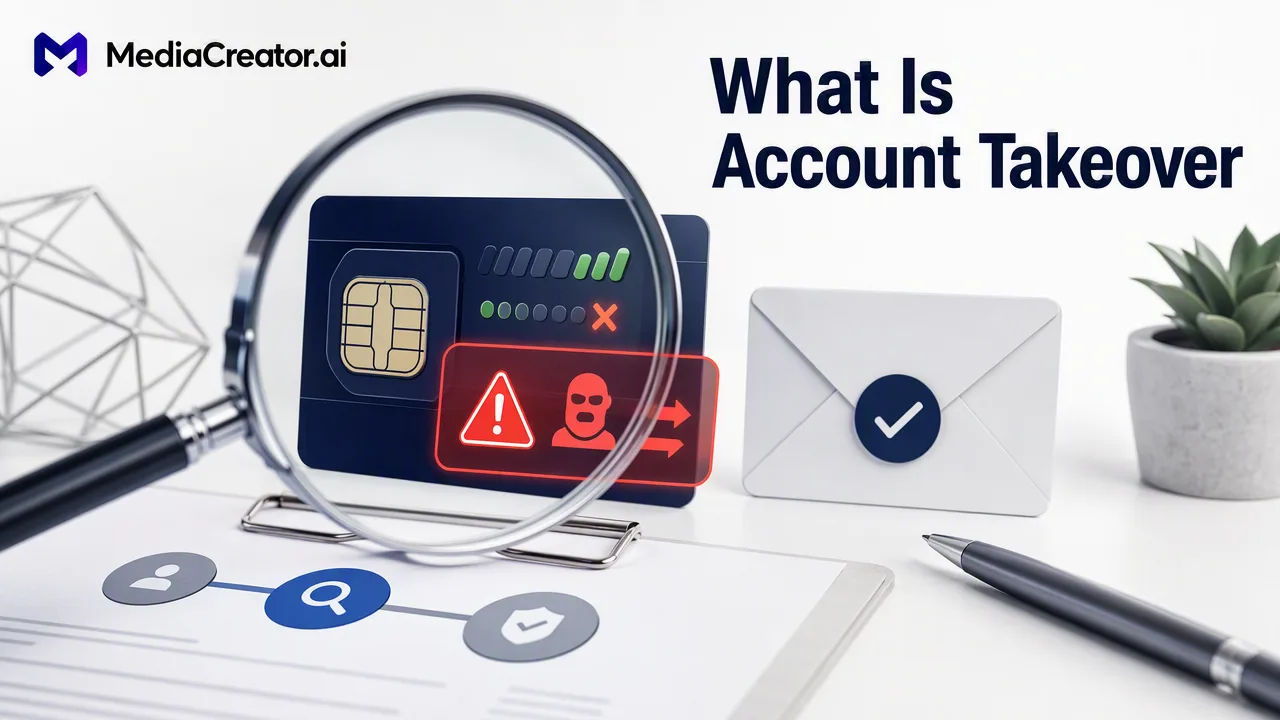
Account Takeover (ATO) fraud is a cyberattack where unauthorized actors gain control of user accounts using stolen credentials or identity manipulation. This glossary entry defines ATO, outlines common attack vectors like phishing and SIM swapping, and explains how phone and email risk signals help security teams detect suspicious activity.
Account Takeover (ATO) fraud occurs when an unauthorized actor gains control of a legitimate user's account through stolen credentials or identity manipulation. By leveraging techniques like phishing, credential stuffing, or SIM swapping, attackers bypass standard security to access sensitive data or perform unauthorized actions, necessitating robust risk-signal monitoring to identify and mitigate suspicious login attempts.
Defining Account Takeover (ATO) Fraud
Account Takeover (ATO) fraud is a type of cyberattack where an unauthorized party gains illicit access to a user's account. Attackers typically exploit this access to steal sensitive data, commit financial fraud, or perform unauthorized actions under the guise of the legitimate user. Because it relies on compromised credentials or identity-based manipulation rather than brute-forcing system vulnerabilities, ATO fraud is a significant risk for any platform managing user accounts. It represents a primary threat to digital security and user trust, requiring continuous monitoring to detect anomalies in account behavior.
Common Attack Vectors
Attackers rely on several established methods to bypass authentication and execute account takeovers. Understanding these attack paths helps security teams implement the right detection mechanisms.
- Credential stuffing: This automated attack uses stolen passwords and usernames from previous data breaches on other platforms. Because users frequently reuse passwords across multiple services, attackers can programmatically test these leaked credentials to unlock accounts.
- Phishing: This technique deceives users into voluntarily revealing their login information. Attackers use fraudulent emails, messages, or websites that mimic legitimate services to harvest credentials directly from the victim.
- SIM swapping: In this targeted attack, a malicious actor convinces a mobile carrier to transfer a victim's phone number to a SIM card controlled by the attacker. With SIM swapping, attackers intercept SMS-based multi-factor authentication codes and reset account passwords.
Detecting ATO with Risk Signals
While traditional security protocols are foundational, modern authentication workflows increasingly rely on risk signals to detect suspicious account activity. Phone and email risk signals help identify anomalies during the login or password reset process. For example, checking the validity, recent porting history, or carrier status of a phone number can flag potential SIM swapping attempts before an SMS code is sent. These signals provide critical decision-support for security teams to review potential threats. Rather than acting as a standalone replacement for comprehensive security protocols, verification signals integrate into broader fraud prevention workflows. They help teams prioritize reviews, trigger step-up authentication when risk is elevated, and support overall user account security. For more information on implementing these checks, explore related use cases, compare verification workflows, or review pricing options.
FAQ
How does credential stuffing lead to ATO?
Credential stuffing leads to ATO when attackers use automated tools to test combinations of usernames and passwords leaked from other platform breaches. If a user reuses the same password across multiple sites, the attacker successfully logs in and takes over the account.
Can phone verification help prevent account takeover?
Phone verification adds a risk signal that helps identify suspicious account activity. By checking phone data—such as recent SIM swaps or carrier changes—security teams gain decision-support to flag high-risk login attempts or trigger additional authentication steps.
What is the difference between phishing and ATO?
Phishing is the method used to steal credentials, whereas ATO is the resulting outcome. Phishing deceives users into revealing their login information, which attackers then use to execute an account takeover and gain unauthorized access to the account.
Get Started with MediaCreator.ai
Discover the power of AI-driven content creation
Related Articles
Continue learning with these related guides
Mitigating Ad Fatigue: A Data-Driven Approach
Learn how to mitigate ad fatigue using data-driven scheduling, creative variety, and AI assistance to maintain audience trust and engagement.
BlogBuilding Digital Authority for AI Search Visibility
Learn how to build digital authority for AI search visibility using consistent, multi-platform content strategies and AI-assisted workflows.
Blog